


Social Media Tips: Continued
Following my first blog post covering platform-specific social media tips, I want to touch on an aspect of social media that a lot of my professional and consulting clients ask about, influencer marketing.
Like most marketing activities, working with influencers can be very beneficial for a brand when done correctly. From helping spread word-of-mouth through a blog or social content to driving an increase of overall awareness for a brand. Influencer marketing enables a company to insert itself authentically through the interests of its target audience.
Let me guess when you think of influencer marketing, you think of well-known brands like Nordstrom, Crown Royal, and Target, but that shouldn't scare you, and I'll tell you why.
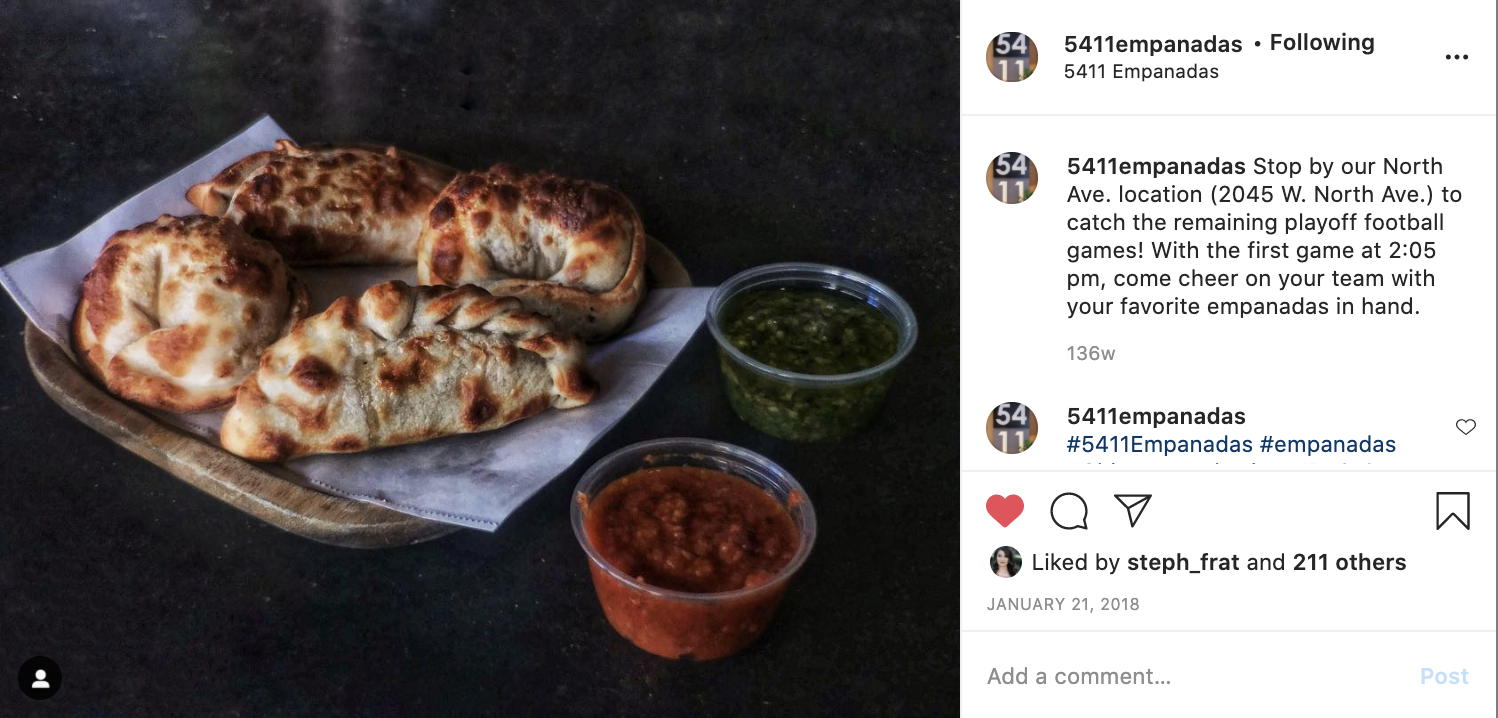
One of my content shoots from 5411 Empanadas, a Chicago restaurant with multiple locations.
One of my former consulting clients is a co-owner of a multi-location, quick-service restaurant in Chicago, 5411 Empanadas, and was interested in influencer partnerships to promote a new product launch. But it needed to happen with a limited budget in mind. With some determination and social listening, I was able to do just that for my client.
I did it by identifying and reaching out to up and coming food and beverage influencers in Chicago with smaller follower counts; we're talking less than 3,000 on Instagram, similar to a micro-influencer.
In exchange for a free meal and the opportunity to capture some photo and video content at one of the restaurant's locations, my client received User-Generated Content (UGC) to share on their restaurant's social channels, and we earned additional reach through the influencers' social channels as well.
To wrap up this section on influencer marketing, I wanted to share a more tactical approach to building brand advocates for small businesses.
Brand Advocates
Like user-generated content, brand advocates are low-cost, and if you're lucky, a free marketing tool can help your business. Brand advocates are your most faithful and intense customers, who will take action if asked. The customers leaving positive feedback on a brand's comments or the Amazon review section are brand advocates.
Most small to midsize businesses lack the resources to either hire a large client success team or pay for chatbots to handle the heavy lifting. An absence of either can result in lost leads and lost sales, but you can level the playing field by utilizing brand advocates. They can be vital to the success of businesses, especially those with limited marketing budgets. Here's how:
Unlike influencers or brand ambassadors, brand advocates engage with a brand because they genuinely love it. These brand advocates can have a sphere of influence themselves but on a much more micro level.

A Fireball Whisky brand advocate, excited about our “Surprise & Delight” kit we sent him.
Like this Fireball Whisky fan above, brand advocates are people who find a way to talk about their experiences and satisfaction with your brand, no matter the scenario. Brand advocates often lead to new customers through word of mouth marketing (WOMM).
They can help build brand affinity, increase overall awareness, and assist in supporting new product launches.
So let's talk about the benefits of a brand advocacy program in the real world and how it can benefit your business. I think a brand that does a great job at building brand advocacy is the shoe company Toms. Those who don't know the company, Toms started in California with both a unique style of shoes and a great category differentiator.

How Toms continues to do social good, even during COVID-19.
Tom's will donate another pair of their shoes to a person in a developing country for every pair of Toms shoes purchased on their site. Even now, during COVID-19, Toms is finding ways to take their profits and turn it into a social good by purchasing personal-protective equipment (PPE).
When thinking about what "reward" your customer could receive for buying your product, it can be something tangible like a coupon for a future visit or points towards a loyalty program. But it can also be something intangible, something that evokes an emotional feeling.
For Toms, the reward is knowing that your purchase will help someone in need with every shoe you purchase. Toms’ brand advocates then take that brand story about why this particular shoe brand is such a great company, and they tell everyone they can, their friends, family, co-workers, and even the person they sit next to on the plane.
Those individuals happen to be potential customers for Toms. Now in an ideal world, those potential customers will go out and purchase a pair of shoes as soon as they hear about how great Toms is as a company, creating new revenue streams.
Leveraging Word Of Mouth Marketing (WOMM)
As a marketer and consumer, there's often some lag time between when someone hears about an exciting product or company and acts on it. We’re talking about multiple touchpoints before a consumer becomes a customer. Sometimes you may not get a direct sale through your brand advocates, but you will gain word of mouth and hopefully convert later.
If you dedicate time to building a brand advocacy program, you also can provide a baseline of customer support without adding to your bottom line, requiring additional resources. For one of my previous agency clients, when we'd see a customer leave a negative comment about issues with their products on Facebook, other users, aka brand advocates, would come out of the woodwork and provide advice or tips to remedy the situation.
One example of a successful brand advocacy program that sticks out in my mind to this day was from a book I read when I was first starting in advertising called "Fizz: Harness the Power of Word of Mouth Marketing to Drive Brand Growth" by Ted Wright.

Fizz: Harness the Power of Word of Mouth Marketing to Drive Brand Growth by Ted Wright
In his book, Ted talks about how his marketing agency in Atlanta, Fizz, helped the U.S. Dairy Association through brand advocates and word of mouth marketing. One of their goals was to get pre-teens and teens to keep drinking milk through high school. And to do that, they needed a story worth telling. That story was a research study concluding that chocolate milk was the best drink following strenuous activity for recovery. Better than Gatorade, water, and everything in between.
Now they needed to change how their potential audience, pre-teens, and teens think about chocolate milk. And who leaves a more significant impression on middle schoolers more than anyone? High school kids. So now, Ted and his team needed to identify and partner with brand advocates who have an authoritative voice on this particular subject, fitness. When it comes to fitness and playing your best in high school, most students look to the football coach for guidance.
Through direct mail, leveraging the study and benefits of chocolate milk, and partnering with professional athletes, the agency convinced coaches in Ohio that chocolate milk should be their players' post-workout drink of choice. Over time, more and more coaches started recommending chocolate milk to their players. Those players then asked their moms for it at home, driving purchase intent at the grocery store. And before long, that local Ohio story gained national coverage, increasing overall sales of chocolate milk.
Takeaways
What are some takeaways from a brand advocacy program, albeit at a much larger scale, that applies to marketers, regardless of skill:
1) Identify your existing brand advocates; they're the people talking about your brand constantly on social or online. You probably already know a couple and could identify more easily with just a little bit of time
2) Establish your goal for partnering with these brand advocates. Is it direct referral, is it app downloads, is it product reviews?
3) What is the creative way to reach those goals? For example, for direct referrals, what can you offer more exciting than a basic "Earn $5 for each referral?"
4) Monitor test and learn. Regarding reporting and analyzing content, we're fortunate to be in an industry where trial and error are not only accepted; and championed when done correctly.
Follow these four takeaways, and as a bonus, you'll be able to build an emotional connection with these potential brand advocates, while also establishing a trusting relationship with your brand or your client's.
With these takeaways, you can create a brand advocacy program with the ability to scale up or down as necessary, that can assist from a content creation standpoint and help you receive product feedback or reviews if your business requires that.
Looking Ahead
We've gone over a lot in the past few weeks, and yet, we've only scratched the surface of the current social media ecosystem. Social media is ever-changing and requires a mixture of both art and science. You need to understand both the qualitative and the quantitative when reviewing content and understanding performance.
And even as social media continues to evolve, we still know that consumers across all of the major social media platforms want to share aspects of their lives and engage with the brands that make it possible for them to do that. So how can your business or your clients engage with its consumers in a natural and non-invasive way? ‘
In my career, we typically mine for insights across the Internet and in the real world, discovering how a brand's products live in everyday consumers' lives. We do this to ground our social strategy in actionable insights.
From a cultural standpoint, what culturally-relevant moments can my brand show up authentically? When thinking about our business category, are we seeing any trends that seem to separate some businesses from others within the category?
Next, we look from a consumer perspective. Can we do social listening to uncover any insights relevant to our brand?
And from a company standpoint, what's truly different about our brand, and how can we maximize that advantage across every relevant media?
During my time at The Escape Pod Group, we took a four-step approach to our social media process. That involves listening to our community, our target audience, and the competitive set for any insights.
1) We look to create original branded content per an editorial calendar.
2) To help supplement that content, we curate and share user-generated content and 3rd party testimonials.
3) We then look to connect with influencers, micro, and macro, to help grow our social following and raise overall awareness.
4) Finally, we take a look back to measure and analyze our results to optimize future content. Like any campaign or activation, review how your content is performing throughout the campaign for better success.
That includes everything from an A/B test using the same creative but different post copy on two paid social posts, all the way to flighting several pieces of content over a more extended period and having them compete against each other.
This A/B testing is sometimes known as race tracking, where you're using the performance of those paid ads to determine which has the best creative to run long-term.
Next week, we're going to continue looking at the organic and paid social content.
Can’t wait and want to learn more about organic and paid social media? Check out my “Organic vs. Paid Social Media: Part 01” blog post.

Organic vs. Paid Social Media: Part 01
During a conversation with a junior Social Media professional that I connected with during COVID-19, we naturally gravitated towards our work. She asked me how I explained to my clients the benefits of organic and paid Social Media in my experience. In this industry, some view this question as an "either-or" scenario; I view it as both sides of the same coin.
The short answer is you're probably going to want to do a bit of both.
Organic and paid social need to be utilized differently depending on your goals, both qualitative and quantitative.
In 2020, Social Media continues to require a holistic approach that balances awareness, with conversion being the end goal. It’ll serve you to know the pros and cons of each, even if you aren't working a budget for paid social.
Even if you've been doing social media for years, 2020 is an exciting time for social media professionals. Social distancing, the closing of many small businesses, and the lack of activities in the real world, overall screen-time usage is going up across the globe.

Source: Digiday
At the same time, ad spend for paid social isn't keeping up with that increase in overall screen time. Many brands are pausing their advertising to take a moral stance against hate speech or save money during an economic downtown. In turn, this has led the major social media platforms to experience volatility in their revenues.
The volatility in ad revenue also means there's evidence that the budget needed to run successful ad campaigns are going down. The great news is, for anyone doing social media marketing, it's an excellent opportunity to either increase your ad spending or get started to reach new leads or purchases instead of brand awareness.
A Statista in March study showcased that Facebook's Cost-Per-Click (CPC) went down from 11 cents to 9 cents between January and March of this year. Doesn't sound like a lot? In Q1 of 2019, just a year prior, the CPC for conversions dropped to $0.55.
So, where does that leave you and your brand's social media marketing strategy? The short answer is that it depends on what your goals are.
What is Organic Social Media?
When I mention organic social media, I'm talking about all of the content (posts, photos, video, memes, Stories) that lives on your feed from all users, including businesses and brands.
From the brand's perspective, when you post organically on your feed, you can expect the people who will see your content, ranked in order of volume:
A percentage of your followers (e.g., your 'organic reach')
People following/discovering any hashtags you use
Your followers' followers (if they choose to share your brand's content)
No matter your brand, organic social media, will be your social media marketing effort's life-blood. Even the brands with the highest ad spend rely on organic social content for various reasons:
For example, brands use organic social to:
build relationships by creating content that is entertaining, educational, and/or inspiring
establish their personality, tone, and voice
giving consumers an opportunity for dialogue, not only with the brand itself but also with other consumers
provide information about a brand through product news or company updates
support their customers with customer service efforts
While you can do all of these things with paid content, you're much likelier to 'tell your story' to a consumer who may not be interested in your brand due to a broad ad set. As such, organic content is the best way to nurture a 1:1 relationship with your customers, at scale
Here are a few examples of organic social content from various brands across multiple industries to better understand:

Chicago Designer and Entrepreneur JoeFreshGoods highlighting his partnership with the Museum of Contemporary Art (MCA) in Chicago.
JoeFreshGoods (@JoeFreshGoods), a Chicago designer and business owner, showcased a recent partnership with the Museum of Contemporary Art in Chicago. This creative not only teases his collaboration with the poster for sale, but he also showcases his style through his outfit and accessories.

Just look at that Wagyu Italian Beef sandwich from Tempesta Market.
One of my favorite places to get a sandwich in Chicago, Tempesta Market (@TempestaMarket), also does a great job at organic social content. You can't help but notice the visual appeal of both sandwiches and the salad. And from a copy perspective, they even include a Call to Action (CTA) to place an order by clicking the link in their bio.

Semillas Plant Studio in the Pilsen neighborhood of Chicago.
Finally, I wanted to recognize a local plant studio in Chicago's Pilsen neighborhood Semillas Plant Studio (@SemillasChicago). Not only did this entrepreneur open a small business in the middle of COVID-19, but she's also leaning on her community for support, raising awareness of a new small business that is minority-owned. In less than two months, Semillas grew their Instagram following to over 6,000 followers.
How To Stay Relevant In An Ever-Growing Ecosystem
Now we've seen how brands in a variety of industries utilize organic content to achieve their marketing goals. And like all great things in life, there are some cons to go along with the pros.
All of the major social media platforms like Facebook, Instagram, and Twitter utilize algorithms to help filter out content that the platform believes will not be relevant to you and, in turn, create a negative experience within the app. Essentially, there are too many pieces of content to engage with, let alone view.
Meaning, you and every other user are only seeing a small percentage of all of the organic posts at any given moment. As a creative person, knowing that my content will be filtered out, no matter how relevant it is to your audience, stings a little.

One of my top posts from an engagement standpoint and yet, less than 12% of my following engaged with this piece of content.
According to a 2019 Hootsuite study, organic Reach on Facebook in late 2019 was down 2.2% compared to the previous year. This decline means the average Reach for an organic Facebook post is about 5.5% of a brand's follower count. If we're talking about large brands like a big-box retailer, that number is even smaller.
What brands and advertisers are experiencing is a gradual decline in organic Reach due to various reasons. The number of users on these platforms continues to grow as more people worldwide gain access to the Internet and smartphones.
For humanity as a whole, this is a positive thing; however, on social media, that means there is an over-saturation of content. All of this content and very little time to consume it.
We know that attention spans are getting shorter. Combine the two, and it's no surprise that our collective brains struggle to process the amount of information coming from our phones.
On top of that, we're living through social and racial unrest, with these very platforms being abused to spread disinformation and hate speech, causing CEOs of advertisers to rethink their mission.
What that means is that it is now more challenging than ever to get your content seen by your audience, let alone potential customers or fans.
This is where you flip that coin and look to leverage paid social.
What is Paid Social Media?
Paid social media is another form of advertising, like Out-Of-Home (OOH), SEM, or experiential. When brands pay money to have their content shared on Facebook, LinkedIn, Twitter, Pinterest, and YouTube, specifically to reach new audiences who are likely to be interested in their brand or product, that's paid social media. Paid social media exists by either "boosting" a brand's organic content or designing unique advertising units.
As more people increase the time spent looking on their screens, brands see an opportunity to invest more in paid social ads. This increase in overall screen time is also shaping us to be more comfortable with completing transactions directly within the feed using key features like Instagram's shop feature.
And just like organic content, there is a way for any brand or business to utilize paid social ads, regardless of budget or size. We know organic social content is excellent for giving consumers an opportunity for dialogue, not only with the brand itself but also with other consumers. Let's learn how you can use paid social content:
Paid social content is best utilized to target and reach new audiences on social media, to move consumers through the conversion funnel. Brands use paid social content to:
drive conversions (mostly CPG / eCommerce brands)
generate leads for retargeting efforts
promote deals, events promos, or partnerships
raise brand awareness and garner new followers
Comparing Organic and Paid Social Media
As we've discussed, organic and paid social media strategies each have their pros and cons. Let's recap what we've gone over.
When shaping your organic social media strategy, remember the goal is to create content that nurtures your relationship with your audience. Organic social content helps:
establish a brand's personality, tone, and voice
support and retain existing customers through customer service efforts
provide information about a brand through product news or company updates
Despite all of the advantages of organic social content, brands and marketers know that organic content alone will take a significant amount of time to reach established business goals. Yes, organic social content is technically free to post, but there is no clear-cut formula for social success. And as such, marketers need to test and experiment to see actual results.
Flip that coin, and now we're looking at paid social content. For an effective paid social media strategy, your brand's goal is to connect with new customers or audience members. Paid social content helps by:
generating leads for retargeting efforts
driving conversions (mostly CPG / eCommerce brands)
raising brand awareness and garnering new followers at scale
promoting deals, events promos or partnerships
While you need some form of a budget to run paid ads, you don't need to be spending hundreds of dollars a day to do so. I've even had success "boosting" my organic content, a quick recap video post of my talk at SocialRock Conference 2019 to increase its Reach, and hopefully, drive new followers to my page.
For next week's post, I'm going to dive into exactly how one can implement an organic and paid social strategy.

Social Media Tips
With all this newly found free time, I'm finishing off the many half-read books scattered across our apartment. The book I'm finishing up now is "We're All Ears: How to increase your impact, influence, and success online in a noisy world." by Valerie Morris. I had the privilege to share the stage with Valerie at SocialRock Conference 2019 , and even today, hundreds of miles away, I’m learning from her.
One thing, in particular, Valerie touches on is how to build influence by creating authority-building content. And the majority of the time it's done, you have to give first, be helpful. Specifically, "giving away free information is perhaps one of the best ways to build influencer."
So I'm going to do just that, and share some tips, best practices, and learnings around Social Media. The goal will be for you to walk away with ways to maximize your efforts on each platform. To start, we'll be talking about the current social media ecosystem, what's changing there, and how you can implement strategic approaches on various social media platforms.
When Art + Science Intersect
We all know that social media is a blend of both art and science, requiring not only the ability to understand "how" a piece of content performs but also "why" it performed the way that it did. And as social media best practices continue to evolve, and user-behavior on these platforms shifts, brands are continually looking to establish themselves in the social space. Often, the companies behind these social platforms define what successful content is.
And from my experience, it's actively managing and engaging with audiences online that leads to a brand's success. There is a need for brands today to establish an online community that can directly support and embody their goals. I believe that each social media platform can have a purpose for a brand, regardless of size or industry. I'll focus on four big ones for small businesses and entrepreneurs, Facebook, Instagram, LinkedIn, and Twitter for brevity's sake.
Facebook has one of the most massive, most diverse audiences, which is excellent for social content that needs to reach an audience at scale through organic and paid social. Facebook encourages consumers to showcase their love of a brand to their friends and family, which can be done through direct messaging, viewing, liking, or sharing content, engaging with chatbots, and even providing useful contact information directly to the brand.
A tip for improving your content strategy on Facebook is to remember that you don't always have to push out your published content! If you offer useful advice or information to someone and link them to a third-party website or piece of content, they may be more receptive to your brand at a later date since you've already established trust with them by providing useful information, regardless of the source.
On Instagram, content performs well when it highlights an individual or brand's 'best of' moments, inspiring people to go out and live a more aspirational life. Instagram as a platform is an excellent medium for visually-arresting creative while relying less on hard-hitting product messaging, otherwise knowns as the Reason To Buy (RTBs).
For Instagram, think about creating 'Engagement first' content utilizing unique formats like Boomerangs, as a great way to foster engagement. If this is your audience's preferred channel, use key platform features like Instagram Stories and unique functions within them, like Polls or Quizzes.
Linkedin is a great platform to become a thought-leader in your industry by engaging with your current and future LinkedIn connections. It's also an opportunity to share your company's culture with potential customers and job recruits. When thinking about what type of content lives best on LinkedIn, a recent platform survey said 44% of respondents said the last piece of content they read on LinkedIn was straight to the point and provided real value to businesses in their industry.
Finally, Twitter is the best social channel for facilitating brand awareness and direct communication with consumers, and not just because it's my favorite platform. I view Twitter as an excellent platform for connecting with people in real-time and integrating the brand into cultural conversations.
Use Twitter to help your brand stay top-of-mind with consumers, and you can do that without as much of a need for paid support than the other platforms that I've mentioned.
Overall Tips
Regardless of platform, staying top of mind with your consumers is more than just pushing out your content. Impactful social and community management is all about joining conversations and building on them. That doesn't mean only replying to people talking directly to you. I'm talking about joining conversations about your brand, general chatter about your business' industry, and even introducing community members to one another to spark further discussions.
With that said, brands have an opportunity to play a vital role in consumers' daily lives on social media, in a way that feels natural and non-invasive. And through research on user behavior, we know that consumers want to showcase how their favorite brands play a role in their lives online. Consumers expect their favorite brands to engage with them on social when appropriate. They want to see brands' heart,' 'favorite,' and share their content.

Photo by influencer Violet Ezedimora - @violetezedimora
The image above is from an influencer I randomly came across, Violet Ezedimora; please give her channel some love. One of the things about her post that I wanted to talk about is all of the brands she tagged. Violet’s tagged asos, Closet London, and even her Wandler bag.
Community Management
One of the better ways to engage with your brand or client's audience is through community management. Community management is a low-cost, high-reward initiative for brands to stand out in their respective industries and as a brand in the overall social media space. One of the great things about community management is that a company of anywhere between 1-5 people can punch above its weight class and compete with much larger companies by dedicating a little bit of time each day through community management.
We're nearly done with 2020 (don't remind me), and there are STILL are too many brands that believe that social media and community management are a marketing afterthought. Social media is a must for every brand, regardless of industry or size.
And we know this because consumers want to participate in a brand's online community for various reasons. A crucial part of community management is giving consumers an opportunity for dialogue, not only with the brand itself but also with other consumers.
Consumers are looking online and through social for information about a brand through product news or updates. They look for entertainment through engaging or shareable content, more often than not, repurposing content across platforms. And at the end of the day, we're human beings that are looking to build social relationships with one another, and consumers can do that by connecting online.
Community Engagement

These social interactions between brands and consumers can help elicit an emotional reaction, directly attributed to the brand. The photo above is from a recent post by the big-box retailer Target. Prompted by a user’s comment asking the brand to make it easier to label products that Target sources from Black-owned companies, the brand listened. Now on Target.com, there are icons to help shoppers identify and support Black-Owned or -Founded brands.
This is an excellent example of a brand investing in their online communities by listening to their community. This post highlights that Target is creating a two-way conversation for its customers, allowing them to break through an already cluttered timeline.
User-Generated Content
A great way to support an effective yet scrappy content strategy is to leverage User-Generated Content. User-Generated Content, or UGC, is an excellent way to share engaging social content and promote conversations around a brand. UGC enables companies to build brand affinity and foster community growth through additional reach and engagements.
By highlighting individuals that embody a brand's essence through UGC, other consumers are encouraged to share their content using branded hashtags. In turn, this User-Generated Content helps amplify a brand's message through what we call brand advocates.


One brand that I believe does a great job of utilizing UGC is Starbucks and their Instagram feed. In the images above, you’ll see a photo from a woman based in Seattle, Maria, and her fantastic shot of the Haleakala Sun Rise Viewpoint, garnering 51 likes since her posting it on March 08. About 2.5 months later, Starbucks touched the photo up a little bit and reposted it on their channel; it garnered over seventy-thousand likes.
A quick tip about branded hashtags before we move on: create a branded hashtag that's own-able, yet the average user would easily read aloud.
When I worked on Oscar Mayer, we were launching a brand-wide campaign for their new and better hot dogs. I had to sell in the idea of using an unbranded hashtag that allowed us to own the conversation around hot dogs, while still providing utility to users that may feel nervous about using a branded hashtag. Something like For The Love Of Oscar Mayer Hot Dogs didn't feel right to us as a team back then.
If you're launching a new business and don't have enough current customers to create UGC for your company, enroll your team! You may not have a marketing department like larger businesses, but you can still enroll your organization to help support your marketing efforts by capturing and posting content on your behalf.
Stay tuned for more!

243 Years Later, We Endure
On August 26th, my world changed in a few different ways. After nearly 14 months leading all things Social Media for the largest privately-held company in the Medical Cannabis industry, I was being laid off. That alone is a scary enough moment, and only becomes amplified in the middle of record-level unemployment in conjunction with a global pandemic.
Not even before I had 6 hours to process this new change in my life, something bigger happened on that day that affected me, specifically as a Black man living in America. Players in the NBA, WNBA, MLB, and professional tennis player, Naomi Osaka, effectively all went on strike to raise awareness around social justice and racial equity, refusing to play in their respective sports.

Milwaukee Bucks in the NBA Bubble in Orlando, Florida.
This mass strike across multiple major sports professions was all sparked by the Milwaukee Bucks basketball team deciding to sit out of a playoff game to raise awareness around the shooting of James Blake and those individuals who lost their lives in Kenosha at the hands of a murderer.
I tried to focus my energy on finding my next career opportunity; however, as a Black man living in America, I can't put what's going on regarding racial and economic justice on hold. At times like this, I think of a quote from Trevor Noah, "Time and time again, Black people have seen the contract they have signed with society, is not being honored by the society that has forced them to sign that contract."
Everyday citizens are fed up; athletes are fed up, suburban moms are fed up, and young adults in rural areas are fed up. There will always be people saying, "This isn't the right way to do this." But we have a chance to push for real change here. Like anything else in life, we have to choose "Comfort or Growth?"‘
Even now, I think of how African-Americans have been fighting for equality for hundreds of years, and it still feels like we're decades away from true equality. I think about one of my ancestors, who had to buy their freedom and whose entrepreneurial spirit is recognized today.
I'm talking about my Great x5 Grandfather, Free Frank McWorter, and he was the first African American to found a town in the United States. Born in 1777 in South Carolina, Frank McWorter lived as a slave for 42 years and spent years planning his freedom.

Free Frank McWorter - Courtesy of National History Museum of American History
That's right; Frank McWorter was born enslaved nearly two months after the United States of America was born. In 1817, at the age of 40, he had earned enough money to buy his wife's freedom, and two years later, his freedom. In 1836, he later founded New Philadelphia, IL, becoming the 1st African-American to establish a town in U.S. history.
My Grandmother, Dr. Juliet E.K. Walker, worked tirelessly to get his story told, founding the Free Frank New Philadelphia Historic Preservation Foundation. The goal of "The Foundation" is to preserve and bring to the public information about the extraordinary life antebellum African-American pioneer businessman and entrepreneur.
Dr. Juliet E.K. Walker, founder/director, is the author of the only scholarly study that details the life of Free Frank as both a slave and freedman, his founding of New Philadelphia, and his activities as a proprietor to promote its growth. Dr. Walker's book, Free Frank: A Black Pioneer on the Antebellum Frontier (Lexington: University Press of Kentucky, 1983, 1995), a carefully researched study, provides the only documented information on Free Frank economic life and his town of New Philadelphia.

Free Frank: A Black Pioneer on the Antebellum Frontier
The mission of the Foundation is to capture the significance of Free Frank as a historical figure, and as a basis to further serious inquiry into the historical continuity of African-American entrepreneurship. Including slave and free, Black men and women who lived in the United States during the age of slavery.
Through intensive lobbying and effort, Dr. Walker had the gravesite of her great-great-grandfather declared a National Register of Historic Places in 1988. Free Frank's gravesite is one of three in Illinois listed in the National Register of Historic Places.
The other two are President Abraham Lincoln and Illinois Senator Stephen Douglas. The Free Frank New Philadelphia Historic Preservation Foundation has launched plans to restore the Free Frank Family Cemetery and film a documentary on the life and history of Free Frank and New Philadelphia, Illinois.

The geographic location of New Philadelphia, Illinois. Courtesy of Department of Anthropology University of Illinois, Urbana-Champaign
She even started a website back in the early 2000s (I should ask Grandma for the keys to update the site) to raise awareness of this American entrepreneur. It took decades of hard work, but President Barrack Obama finally listened. President Obama's support led to New Philadelphia's designation as a National Historic Landmark (p. 709).

3 Generations of the McWorter Family
I am fortunate to have the ability to trace my ancestors' journey in this country, all the way back to 1777. Many Black people in America are not as fortunate, which can weigh on someone both mentally and spiritually. And yet, people who look like me still hear "Go back where you came from" from people who don't look like me. Good thing I'm already home.
My family has fought for equality and a better life since the founding of our country. And on August 27th, 2020, I plan on continuing that fight for those before and after me.
For more information about Free Frank McWorter, and my Grandmother's work, click here.

A Nation In Unrest
I knew things were different the moment the 1st coworker to reach out to me asked how I was feeling, and I broke down shortly afterward for the 1st time.

Photo Credit: Alice Xiao (@AliceXiaoCreative)
I don't know where to start, but I do know when things will end.
I knew things were different the moment the first coworker to reach out to me asked how I was feeling, and I broke down shortly afterward for the first time.
I knew things were different when I struggled to get back to work as if nothing had happened. My heart hurt because I knew that was being expected of me and many others that look like me. To just grin our teeth and persevere on top of the everyday struggles we face.
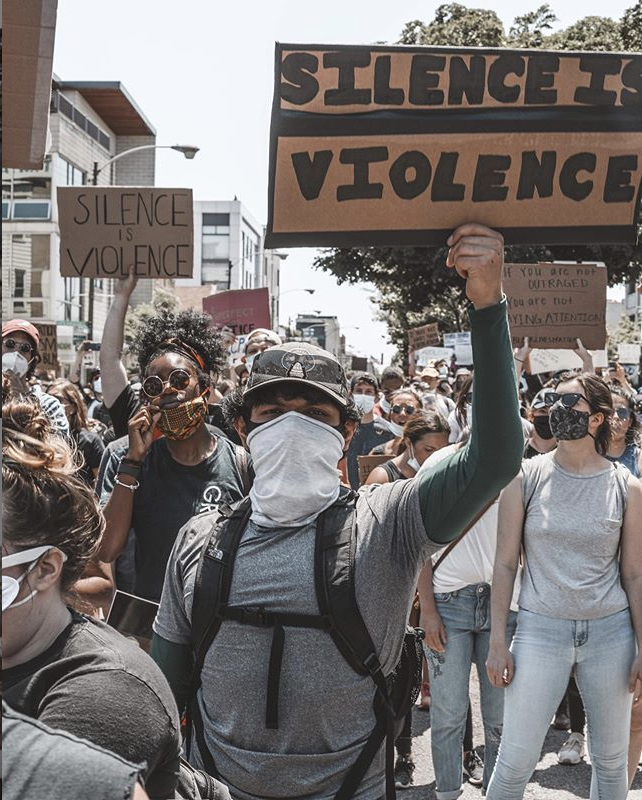
Photo Credit: Alice Xiao (@AliceXiaoCreative)
I knew things were different when, like many of you, I didn't know what else I could do. I read articles, used my platform to amplify others' voices, reached out to my friends of color, connected with my white friends, and donated money. I saw my favorite artists bringing life to boarded windows. I watched my friends cook meals for first responders, protesters, and those in need out front of their bar, doing what they can.
I knew things were different when I marched with 30,000+ Chicagoans in peaceful protest, taking up all 4 lanes of traffic for 3+ miles. I met friends there before we marched, another friend tapped my shoulder after bumping into us, and we walked home with a different set of friends.
I knew things were different when I woke up today, energized, and with a heart full of pride. I’ll look back, knowing we made the right decision to stand up against injustice. And I’ll look forward, knowing my ancestors proud will be proud of my actions.

Joining The Cannabis Industry
As a Chicagoan, seeing your brands in the publications you grew up reading is a special feeling.

As a Chicagoan, seeing your brands in the publications you grew up reading is a special feeling.
It’s icing on the cake that I’m starting 2020 seeing my Chicago-based brands in @ChicagoMagazine’s cannabis edition celebrating the legalization of weed. And I’ve been fortunate to meet folks that have been leading this industry for years.
But we can’t celebrate something so great without acknowledging the price we paid to get here. As a Black man living in Chicago, I always feared that I was at a higher risk for being arrested for marijuana consumption or possession, 3.73x as likely.
I was luckier than others, and that can’t be forgotten.
Progress takes time, and there will be some hiccups in the road. But I look forward to sharing this journey with you.

